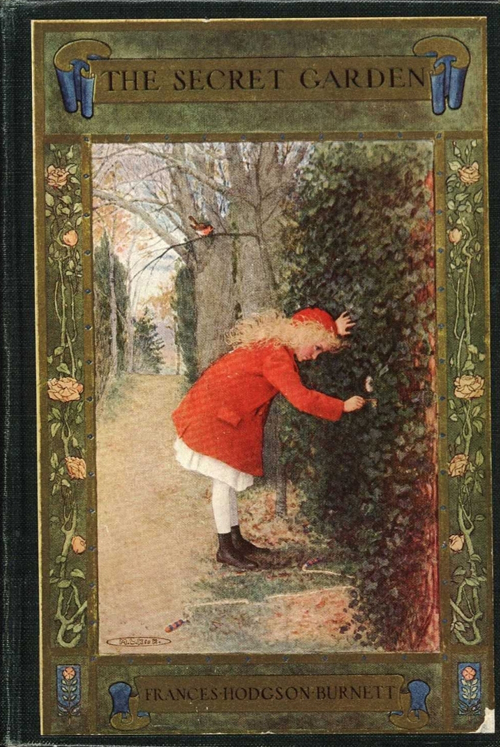
The Secret Garden

The secret garden

When I was in fourth grade, my teacher often had “story time” and read us first rate children’s stories. I think most of the students loved them, just as I did, but some did fall asleep at times (I think it was right after lunchtime). She read Winnie the Pooh stories often, but my favorite was The Secret Garden by Frances Hodgson Burnett. It’s a story about a 9 year old girl named Mary Lennox whose parents had left her in the care of their servants who spoiled and despised her. Both parents died unexpectedly from a cholera epidemic. Mary became an unhappy spoiled contrary child. She was nicknamed “Mistress Mary, quite contrary.”  She was sent to live with her gloomy uncle in his desolate country manor in the Yorkshire moors.

One of top books of all time in Children’s Literature

As the story goes, at her new home she discovers a neglected secret garden at the manor and with the help of two new friends, and a curious robin, find out its secrets. 

Written in 1910 as a series of 10 issues of a magazine of adult readership, its popularity brought it to final book publication in 1911.  Despite being overlooked by literary critics and librarians over the early years, it continued to rank highly on readers polls for favorite stories. 

In the 1960s (around the time my teacher read it to our fourth grade class) the readers of The New York Times ranked it as one of the best children’s books of all times.

Eventually Children’s Literature became a field of great scholarly interest. The era that The Secret Garden was written is considered to be The Golden Age of Children’s Literature (c. 1865–1926). It was a prolific era in Britain and America where literature shifted from moral instruction to entertainment, prioritizing pleasure, fantasy, and adventure. Defined by classics like Alice in Wonderland, Winnie-the-Pooh, Peter Pan and The Wizard of Oz, this period celebrated childhood innocence, wonder, and imagination.

Would you like to read it now? Read it now for free. It is a Public Domain Book available at Gutenberg.org
Stagecoach Mary

Stagecoach Mary

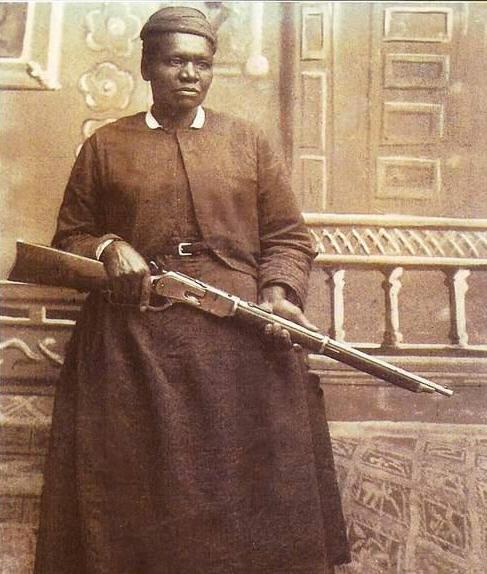
Stagecoach Mary earned her reputation by becoming the second woman in the United States to become a US Postal Star Route carrier. Surviving blizzards, frostbite, wolfpack attacks, outlaws and the treacherous terrain of her 34 mile route. Her strength and determination as a woman on her own, in a territory which challenged the toughest of men, made her a wild west legend.

Mary Fields was born a slave in Tennessee in 1832. She worked in the home of Judge Edmund Dunne and his wife Josephine. When Josephine died in 1883, Mary took the family’s five children from Florida to their Aunt, the Mother Superior of an Ursuline convent in Toledo, Ohio. Mother Amadeus and Mary Fields formed a strong bond which would last their lifetimes.

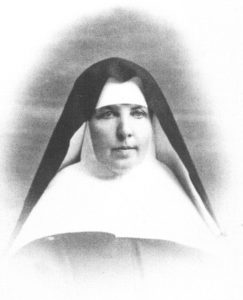
Mother Mary Amadeus

Montana

In 1884 Mother Amadeus and five nuns were sent to Montana to establish a school for Native American girls at St Peters Mission. The harsh Montana winters got the better of Mother Amadeus. When word got back to Mary Fields that Amadeus was dying of pneumonia, she rushed to her side to nurse her back to health. Mary also saw that the nuns and the Mission needed her help so she decided to stay.

Mary Fields worked at St Peters hauling freight, doing laundry, established a vegetable garden, a large chicken hennery, plus tended the livestock. She helped restore the buildings and did the work of two men. Montana suited Mary. Tough as nails, she drank whiskey, smoked cigars, was a crackshot riflewoman and thrived in the free open life of the West.

She became the forewoman of St Peters. But expecting as much from others as herself, her reprimand of a disgruntled lazy suborordinate resulted in his complaint to the Bishop who had her expelled from the Mission. Mary opened a restaurant in nearby Cascade Montana. Mary’s Cafe would serve food to anyone, whether they could pay or not, which made her many friends, but eventually lead to the need to find other work.

Star Route Mail Carrier

In 1895, now 63 years old, Mary became the first African American woman Star Route mail carrier in the United States. Then, for the next eight years, never missing a day, she delivered the mail from Cascade to St Peters Mission, a 34 mile round trip. The job let her visit the Mission on a regular basis to reconnect with Mother Amadeus and the children she had grown to love. And to the people and children of Cascade the the rest of the route, she was the revered “Star Route carrier who forged through impossible elements alone”, telling fascinating tales, bringing their mail and being their connection to the outside world.

By the time she retired in 1903 at the age of 71, surviving near death experiences and the wilds of Montana, she earned her name “Stagecoach Mary”, a legend of western folklore.

Deliverance Mary Fields, First African American Woman Star Route Mail Carrier in the United States: A Montana History